
 Wasatch Front
 Federal R&D Tax Credit Services for Businesses That Invest in Innovation

The federal R&D tax credit is one of the most valuable and most commonly overlooked tax incentives available to U.S. businesses. If your company develops new products, improves processes, or builds software, there is a strong chance some of your existing work qualifies.
CMP’s R&D tax credit specialists work directly with business owners and their teams to identify qualifying activities, calculate the credit accurately, and prepare documentation that holds up under IRS review.
Why Work With CMP for Your R&D Tax Credit?
CMP has served businesses across the country for over 45 years. We are an award-winning, full-service CPA firm with dedicated R&D tax credit specialists who have direct experience in the industries where qualifying research is most common: manufacturing, construction, software, engineering, and more.
Our R&D tax credit studies follow a structured process developed to meet IRS documentation standards. We do not take shortcuts. And because we also handle tax preparation and planning for many of our clients, we understand how the R&D credit fits into a broader tax strategy, maximizing the value of every dollar you spend on innovation.
Tens of thousands saved through expert tax knowledge! Five years using Jared and we’ve always felt like we were getting the best advice, guidance, and tax reduction results available to us.
CMP Client
Custom Flooring and Design
What Is the Research and Development Tax Credit?
The R&D tax credit, defined under Section 41 of the Internal Revenue Code, is a federal incentive that rewards businesses for investing in innovation. Companies that engage in qualified research activities in the U.S. receive a dollar-for-dollar reduction in income tax liability.
The credit is calculated as a percentage of qualified research expenses (QREs) above a base amount. Using the Alternative Simplified Credit (ASC) method, the credit is generally worth 14% of the excess QREs above 50% of your average QREs for the prior three years, often resulting in a meaningful reduction in federal tax liability.
In some cases, qualifying startups can apply a portion of the credit to offset payroll taxes even before generating income tax liability.
Qualifying work generally involves the design, development, or improvement of:
- Products
- Processes
- Software
- Techniques or systems
Are you a startup? The R&D credit can offset payroll taxes.
The R&D tax credit, defined under Section 41 of the Internal Revenue Code, is a federal incentive that rewards businesses for investing in innovation. Companies that engage in qualified research activities in the U.S. receive a dollar-for-dollar reduction in income tax liability.
Who Qualifies for the R&D Tax Credit?
Many businesses qualify without realizing it. You do not need a dedicated R&D department, a lab, or a team of scientists.
You may qualify if your business:
- Develops or improves products
- Improves internal processes or systems
- Designs, tests, or builds prototypes of solutions
- Develops or enhances software
- Solves technical or engineering challenges
No specific industry is excluded. Businesses in manufacturing, software, engineering, construction, and agriculture commonly qualify, but companies across more than 40 industries have successfully claimed the credit.
What Activities and Expenses Qualify?
Qualifying Activities
Activities that may qualify include:
- Developing new or improved products
- Improving functionality, reliability, or performance
- Evaluating design alternatives
- Testing prototypes and refining designs
- Developing or improving manufacturing or technical processes
- Developing or integrating software systems
Qualifying Expenses
Eligible expenses typically include:
- Employee Wages: Wages for employees directly involved in development, testing, or technical support activities.
- Supplies: Materials used in prototyping, testing, or development.
- Contract Research: 65% of payments to third parties performing qualified research on your behalf.
- Cloud Computing Costs: Costs directly associated with the rental or lease of computing power used for Qualified research can qualify.
The Four-Part Test: Does Your Work Qualify?
To qualify for the federal R&D tax credit, activities must meet the IRS four-part test. Every part must be satisfied.
1. Permitted Purpose
The activity must aim to create or improve a product, process, software, or system specifically in terms of functionality, performance, reliability, or quality.
Example: Improving the durability of a product or increasing the efficiency of a manufacturing process.
2. Technological in Nature
The work must rely on principles of engineering, physics, computer science, or other hard sciences. It must involve technical problem-solving, not routine business operations.
Example: Developing a new software architecture or redesigning a mechanical component using engineering principles.
3. Elimination of Uncertainty
At the start of the project, there must be genuine uncertainty about whether the outcome can be achieved, how it can be achieved, or what the final design should look like.
Example: Not knowing whether a material will meet performance requirements, or whether a system can handle a specific load.
4. Process of Experimentation
The work must involve a systematic process of testing and evaluating alternatives to resolve that uncertainty, such as prototyping, modeling, simulation, or trial-and-error.
Example: Testing multiple design options to determine which performs best under real-world conditions.
How the R&D Tax Credit Benefits Your Business
The R&D tax credit is a dollar-for-dollar reduction in your federal income tax liability, not just a deduction. Every dollar of credit directly reduces what you owe.
Key benefits:
- Dollar-for-dollar reduction in federal income tax liability
- Carry unused credits forward up to 20 years
- Payroll tax offset for qualifying startups (up to $500,000/year)
- Retroactive claims for open prior tax years (generally the prior 3 years)
- Credits for work your business is already performing, no new R&D spend required
For many businesses, the R&D tax credit represents a significant return on activities they were already doing.
How to Claim the Federal R&D Tax Credit
The R&D tax credit is claimed by filing Form 6765, Credit for Increasing Research Activities, with your federal tax return. Accurately claiming the credit requires both proper calculations and strong supporting documentation.
The process typically involves:
- Reviewing prior tax returns and financial records
- Identifying qualifying projects and activities
- Analyzing employee wage data and time allocation
- Gathering technical documentation
- Calculating qualified research expenses (QREs)
- Preparing supporting documentation to meet IRS requirements
Supporting documentation typically includes:
- Payroll records and W-2 data
- Time tracking or project allocation data
- General ledger and financial records
- Technical design documents, specifications, or test results
- Internal project approval or development documentation
Proper documentation is not optional; it is your primary defense if the IRS reviews your claim. CMP prepares documentation designed to meet IRS standards from the start.
Not Sure If Your Business Qualifies?
If your company is developing products, improving processes, or building software, it may be eligible for the R&D tax credit. Request a free eligibility assessment to find out whether your activities qualify and what your next steps should be.
Our R&D Tax Credit Process
CMP uses a structured, IRS-compliant approach to identify, calculate, and document R&D tax credit claims.
Identify Qualifying Activities
Gather and Analyze Data
Perform the R&D Tax Credit Study
Prepare Documentation
Support Filing and Audits
Industries That Commonly Qualify for the R&D Tax Credit
The R&D tax credit is available across industries. Any business that develops, improves, or tests products or processes should evaluate its eligibility. Industries that frequently qualify include:
- Manufacturing – process improvements, tooling, new product development
- Software / SaaS – new features, architecture development, platform integration
- Engineering – design work, structural analysis, systems development
- Construction – design-build projects, custom engineering solutions
- Agriculture – crop improvement, equipment development, yield optimization
- Biotechnology & Life Sciences – drug development, clinical processes, lab systems
- Aerospace & Defense – component design, testing programs
- Food Processing – formulation, packaging improvements, production process optimization
R&D Tax Credits by State

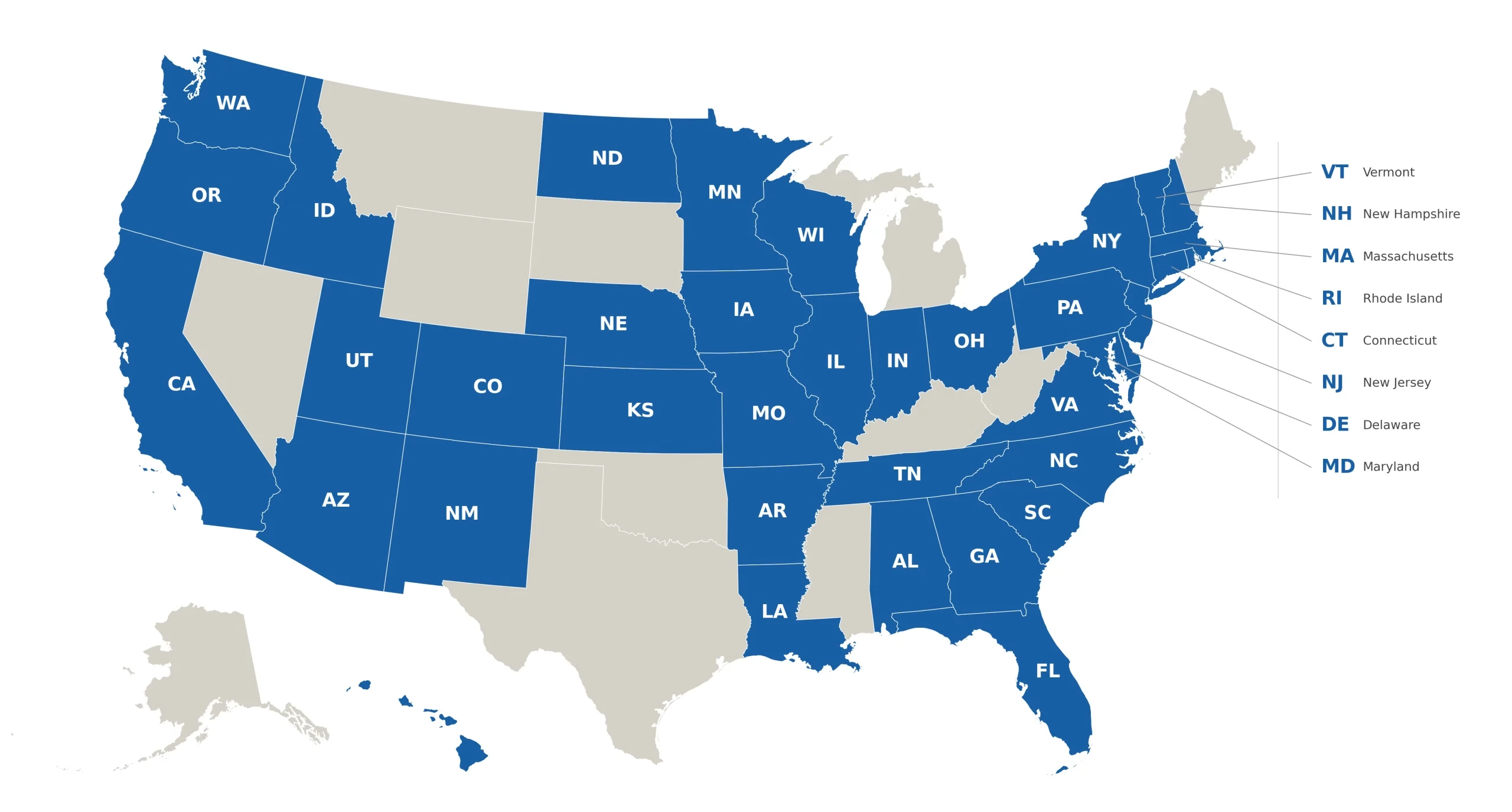
In addition to the federal R&D tax credit, many states offer their own research and development incentives. These programs vary by state and can provide additional tax savings depending on where your business operates.
States that offer R&D tax credits include:
Alabama, Arizona, Arkansas, California, Colorado, Connecticut, Delaware, Florida, Georgia, Hawaii, Idaho, Illinois, Indiana, Iowa, Kansas, Louisiana, Maryland, Massachusetts, Minnesota, Missouri, Nebraska, New Hampshire, New Jersey, New Mexico, New York, North Carolina, North Dakota, Ohio, Oregon, Pennsylvania, Rhode Island, South Carolina, Tennessee, Utah, Vermont, Virginia, Washington, Wisconsin
If your business operates in Utah, you can learn more about the state-specific credit here: Utah R&D Tax Credit Services →
Frequently Asked Questions About the R&D Tax Credit
HOW DO I KNOW IF MY BUSINESS QUALIFIES FOR THE R&D TAX CREDIT?
HOW MUCH IS THE R&D TAX CREDIT WORTH?
WHAT DOCUMENTATION IS REQUIRED TO SUPPORT AN R&D TAX CREDIT CLAIM?
CAN WE CLAIM THE CREDIT FOR PREVIOUS TAX YEARS?
DOES MY STARTUP QUALIFY FOR THE R&D TAX CREDIT?
WHAT CHANGED WITH THE R&D TAX CREDIT AFTER 2022?
WHAT HAPPENS IF THE IRS AUDITS OUR R&D TAX CREDIT CLAIM?
WHAT FORM IS USED TO CLAIM THE R&D TAX CREDIT?
HOW LONG DOES AN R&D TAX CREDIT STUDY TAKE?
Work With an Experienced R&D Tax Credit Team
CMP provides practical, compliant R&D tax credit services for businesses investing in innovation and seeking to recover a portion of that investment under the federal tax code.
Our approach focuses on:
- Identifying qualifying activities across your operations
- Preparing accurate credit calculations using IRS-accepted methods
- Building clear, audit-ready documentation from the start
- Coordinating with your existing tax preparer or handling the full return
If your business is developing products, improving processes, or building software, the next step is straightforward: find out how much of that investment you can recover.
Meet Our R&D Tax Credit Specialists:

Jared has been preparing tax returns and helping clients with various accounting and tax needs since 2001. He started his career in public accounting at..

Quinn Johnson is a Tax Manager in the Logan office at CMP. He graduated in December 2022 with a Master’s Degree in Accounting from Utah State University..
Evaluate Your R&D Tax Credit Opportunity
Our team will assess your eligibility, walk you through the credit calculation, and help you understand exactly how the credit applies to your business—at no cost.
Request a Free Eligibility Assessment →